

Beskrywing
Most marketing teams can’t answer a simple question: which campaigns, ads, and keywords actually turn into revenue? GA Connector answers it, right inside your CRM.
Why marketers use GA Connector
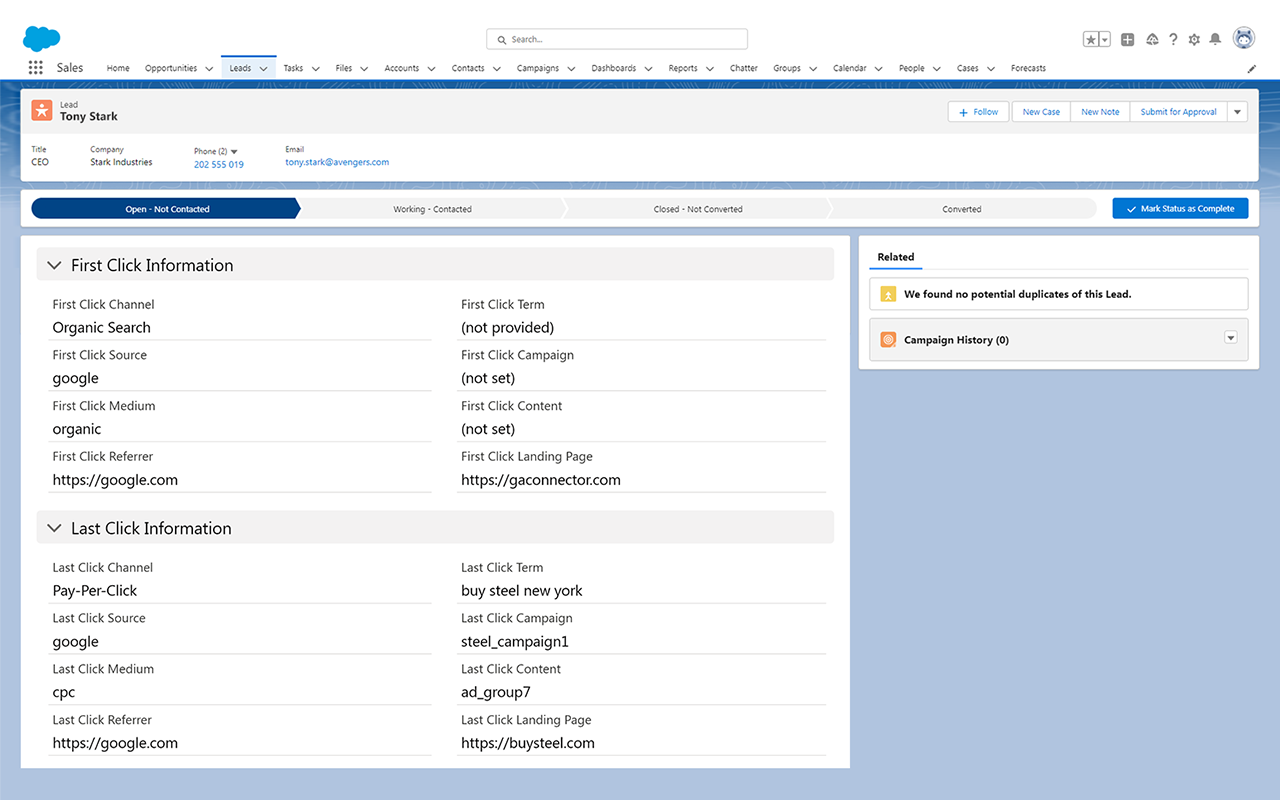
- See the true source of every deal. Every lead and closed deal in your CRM shows the campaign, keyword, and ad that created it.
- Tracking that survives ad blockers and browser privacy features. Third-party scripts get blocked; this plugin runs first-party, through your own domain and server, so it keeps working.
- Every traffic source covered. Google Ads, Facebook Ads and other paid channels, plus organic, social, referral, and email.
- Marketing ROI without the enterprise price tag. Report revenue by campaign, channel, and keyword. No full-blown attribution suite required.
- GDPR-ready. The plugin captures nothing about the visitor on your server as the page loads; with manual script injection, the tracker runs only after your consent banner or tag manager allows it.
Requires a GA Connector account. The plugin is free with no locked or trial-limited features; the GA Connector service it connects to is a paid subscription with a 30-day free trial. Full details in External services below.
What you’ll see in your CRM for each lead and deal
- First-click and last-click attribution: channel, source, campaign, keyword, ad content, and landing page.
- All UTM parameters (source, medium, campaign, term, content) and click IDs like
gclid. - Visitor details: location, device, browser, pages visited, and time on site.
How it works
- A visitor lands on your site, and the tracker records the page they landed on and where they came from, read in the visitor’s browser.
- The GA Connector tracker loads from your domain instead of a third-party one, so ad blockers and browser privacy features leave it alone.
- Page views and lead details are sent to your own site first, then relayed securely to GA Connector with your API key attached on the server, never in the browser.
- GA Connector matches that activity to the leads and sales in your CRM and reports on what’s driving revenue.
Key plugin features
- First-party, server-side tracking through your own domain.
- API key stays private on the server, never in your page source or visible network requests.
- GDPR-ready: nothing about the visitor is captured on your server as the page is built; with manual script injection, nothing runs until the visitor accepts consent.
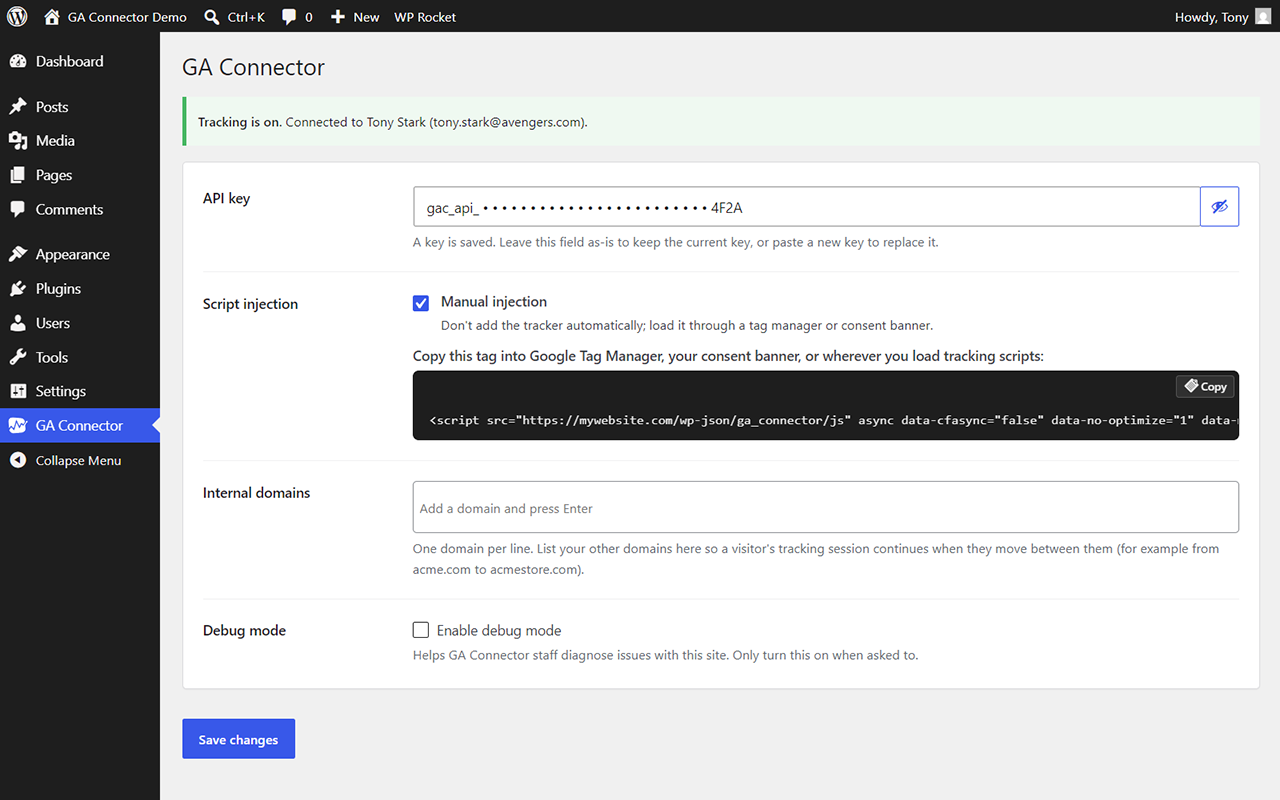
- Works with your consent banner or Google Tag Manager via manual script injection.
- Works with any caching setup, including full-page caching.
- Multisite-ready; setup is pasting your API key.
Powered by the GA Connector service
- Records where each visitor came from: the campaign, source, keyword, referrer, device, and location.
- Follows a visitor across multiple visits, devices, and your different domains.
- Links that history to the leads, contacts, and closed deals in Salesforce, Zoho CRM, Pipedrive, or Close.
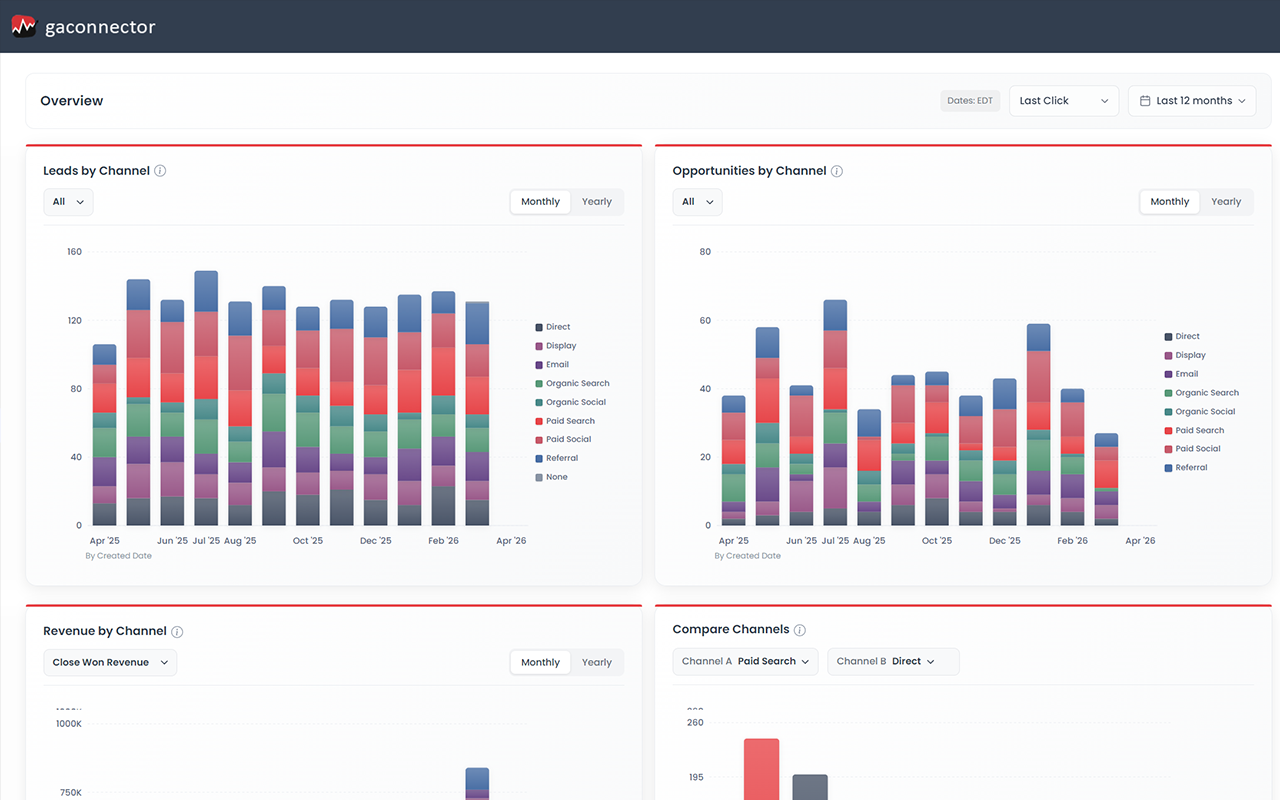
- Reports on which marketing sources actually generate revenue, broken down by campaign, channel, and keyword.
GA Connector is a full attribution and reporting product; this plugin is the first-party connection to it.
Supported CRMs
This plugin works with Salesforce, Zoho CRM, Pipedrive, and Close. Using a different CRM? Other versions of GA Connector cover additional CRMs. See gaconnector.com for the full list.
External services
This plugin acts as a first-party, server-side proxy to the GA Connector tracking service.
What the service provides
GA Connector records where your website visitors came from (UTM parameters, referrer, gclid, device, geolocation, etc.) and links that attribution to leads and closed deals in your CRM (Salesforce, Zoho CRM, Pipedrive, or Close). On your behalf, the service stores each visitor’s full attribution history, applies multi-touch attribution across visits and devices, stitches visitor identity across your domains, enriches your CRM records with that data, and generates the reporting dashboards that attribute revenue to sources and campaigns. GA Connector is a full analytics/attribution product, not a licensing, validation, or storefront mechanism.
Why the plugin requires it
All of the processing above (storage, attribution modeling, identity stitching, CRM enrichment, and reporting) happens in the GA Connector service; the plugin has no local equivalent of that functionality. The plugin’s role is to capture tracking signals first-party on your server and relay them. Without a GA Connector account and API key the plugin has nothing to relay to, so it is not functional on its own (beyond its settings screen).
What runs where
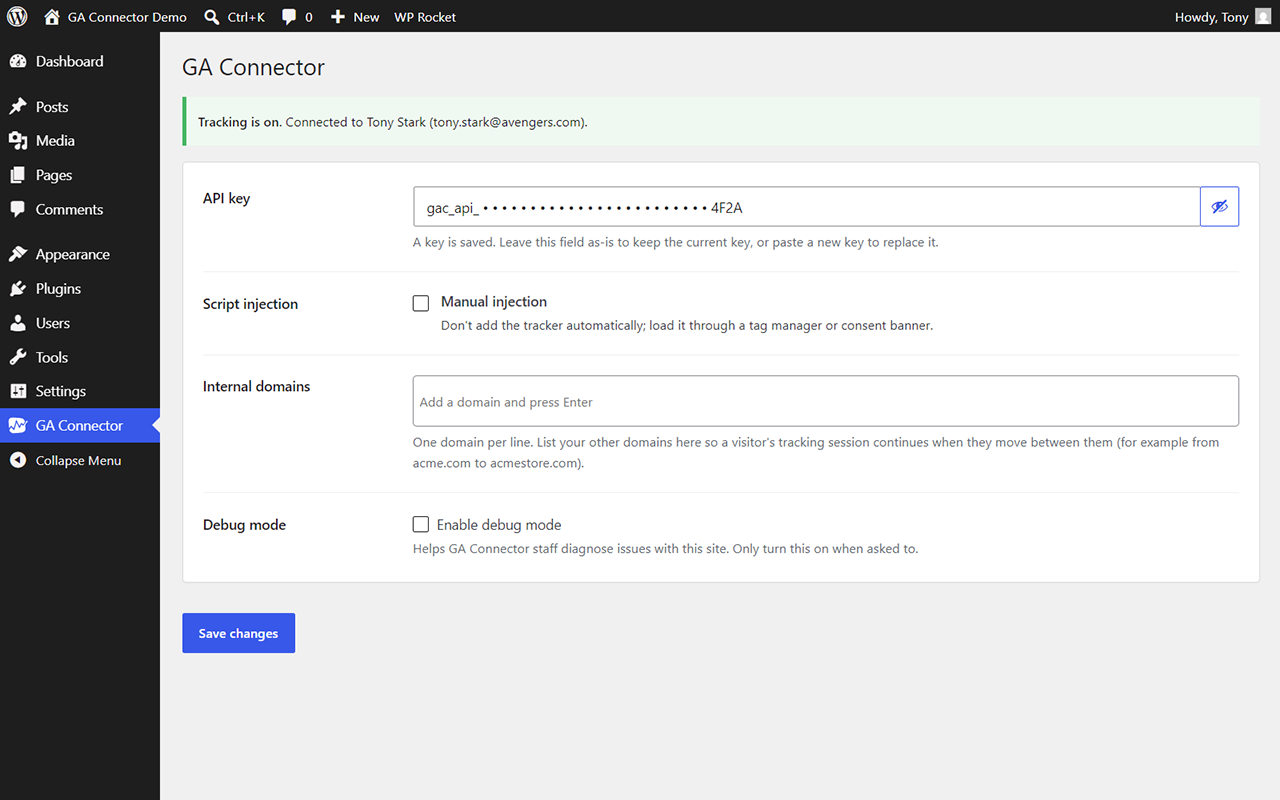
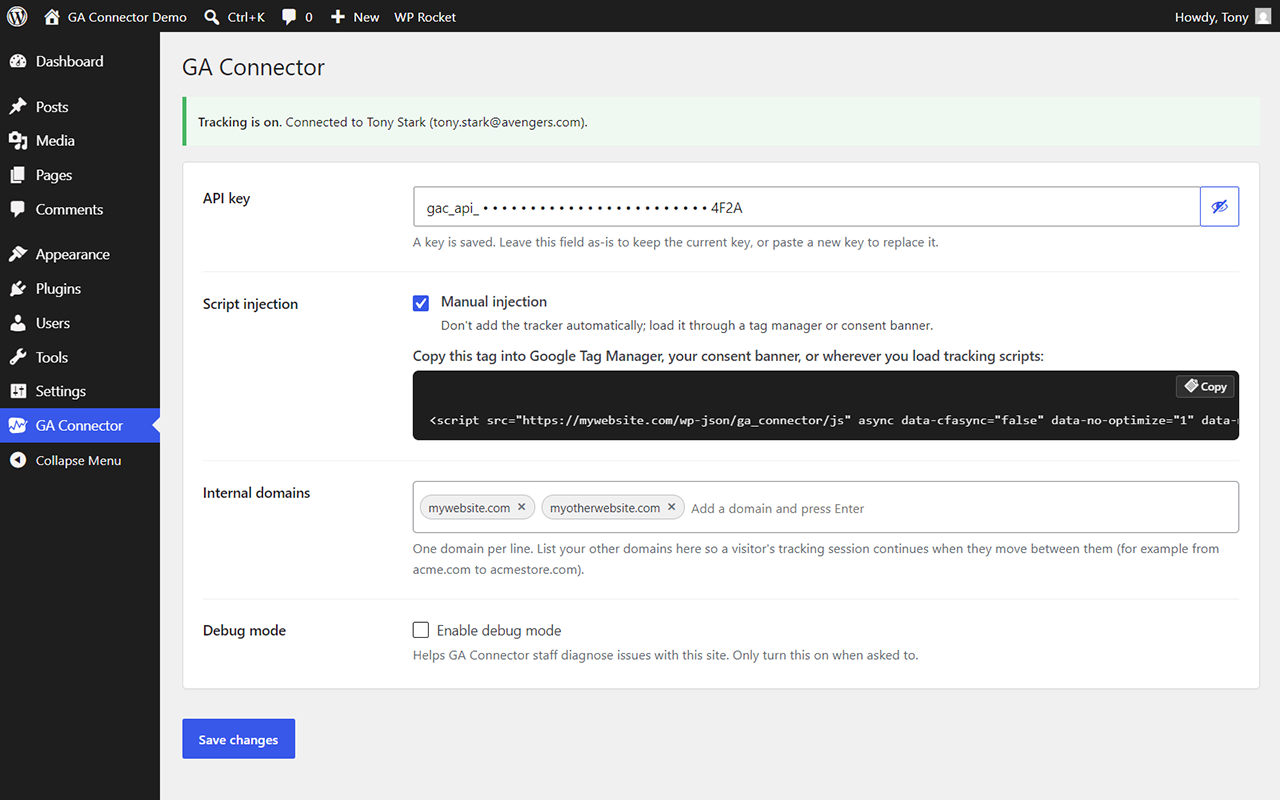
- In the plugin (local, GPL): the settings screen, the first-party REST endpoints on your domain, server-side delivery of the tracker script, script-injection control (automatic or manual), API-key storage, and the cross-domain internal-domains list.
- In the service: attribution storage and modeling, cross-device and cross-domain identity, CRM enrichment, and revenue reporting dashboards.
When your site connects to the service, and what is sent
Your site connects to the GA Connector API at track.gaconnector.com in the following cases:
- When you save your API key on the settings page (and each time that page is rendered), the plugin calls
GET /api/v1/accountwith your site’s domain and your API key attached as a Bearer token. This verifies the key and confirms the domain is registered on your account. No visitor data is sent. - On every front-end page render (in automatic mode), the browser loads the tracker script from your own domain at
/wp-json/ga_connector/js; the plugin fetches the canonical tracker script server-side viaGET /api/v1/js. Only your site’s origin is sent; no visitor data is sent. - When the tracker script runs in the visitor’s browser (immediately in automatic mode, or only after the visitor consents when it is loaded via a consent banner/Google Tag Manager in manual mode), it POSTs events to your own domain at
/wp-json/ga_connector/events/pageviewand/wp-json/ga_connector/events/identify. The plugin forwards these server-side toPOST /api/v1/events/...with your API key attached. Pageview events send: a visitor id minted in the browser, the page URL, the referrer, the user-agent, the visitor’s IP address (determined by your server from the request), and a timestamp. The page URL, referrer, and user agent are read in the visitor’s browser. Identify events are sent when a visitor enters an email address into a form field (the tracker detects this automatically) or when your site calls the tracker’s identify API; they send the visitor id plus the identifier name and value (the email address is SHA-256 hashed in the browser before it is sent). Your API key is never exposed to the browser.
Account, terms, and privacy
A GA Connector account and API key are required. GA Connector is a paid subscription service; a 30-day free trial (no credit card required) is available at gaconnector.com. Use of the service is subject to GA Connector’s Terms of Service and Privacy Policy. For details on data handling and GDPR, see the GDPR guide.
Consent
The plugin adds nothing about the visitor to your pages on the server as the page is built; the page URL, referrer, and user agent are read in the browser instead. It never mints a visitor id or sets a cookie at page-render time; the visitor id and the __gacvid cookie are minted by the tracker script in the browser once it runs, which in automatic mode is as soon as the page loads.
To gate that on consent, use manual script injection so the tracker loads only when your consent banner or Google Tag Manager fires it; then nothing about the visitor is stored or sent until they have accepted consent.
Screenshots
Installation
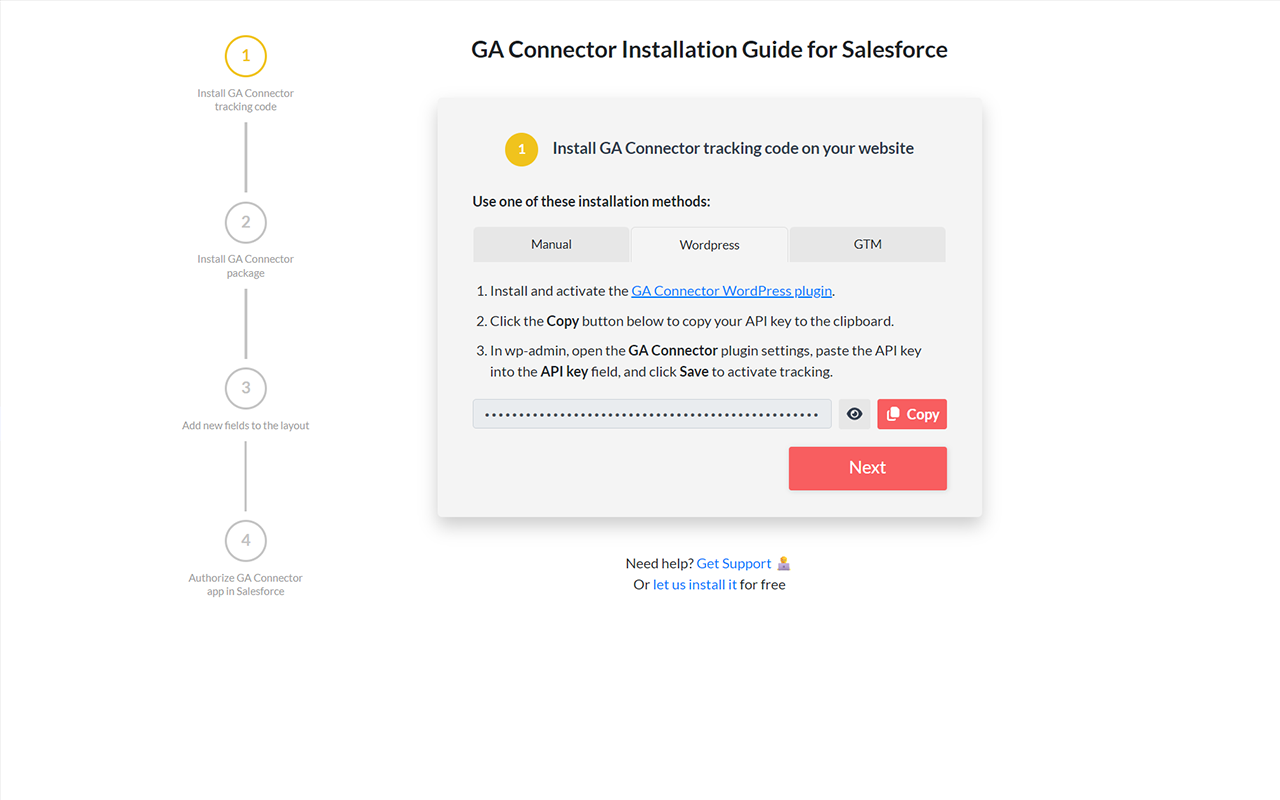
- Sign up (or log in) at gaconnector.com and copy your API key from the GA Connector setup wizard.
- Upload the
ga-connector-crm-ga-integrationdirectory to/wp-content/plugins/, or install the plugin from the WordPress plugins screen. - Activate the plugin in Plugins Installed Plugins.
- Open the new GA Connector menu in wp-admin, paste your API key, and save. This completes the tracking step of the setup wizard.
- Back in the setup wizard, connect your CRM: install the GA Connector package in your CRM (Salesforce and Zoho CRM only), then authorize GA Connector to access it. Attribution data will now flow into your CRM.
Kwel-vrae
-
Is the plugin free? Do I need a paid account?
-
The plugin itself is free and everything in it is fully functional; nothing is locked or trial-limited. It connects to the GA Connector service, which is a paid subscription with a 30-day free trial (no credit card required). You need an account and API key for the plugin to do anything, because the attribution processing, CRM enrichment, and reporting happen in the service.
-
How much does GA Connector cost?
-
Plans are based on your monthly page views, with one price for your entire CRM account and no per-user fees. There’s a 30-day free trial with no credit card required. See current plans at gaconnector.com/pricing.
-
When does the plugin read visitor data?
-
Only in the browser, and only once the tracker script runs. The page URL, referrer, and user agent are read by the tracker in the visitor’s browser; the plugin writes nothing about the visitor into the page on your server, so it does no server-side processing of visitor data as the page is built.
By default the tracker runs automatically on page load, which mints the
__gacvidcookie and sends events. To require consent first, turn on manual script injection and load the tracker through your consent banner or Google Tag Manager, so nothing is set or sent until the visitor accepts (see “Will it work with Google Tag Manager or a consent banner?”).GA Connector cannot determine your legal obligations for you; you are the data controller for your own site, so review your configuration with your privacy counsel. See the Privacy Policy and the GDPR guide.
-
Which CRMs does it work with?
-
This plugin connects to the GA Connector service edition for Salesforce, Zoho CRM, Pipedrive, and Close. If you use a different CRM, other versions of GA Connector are available. See gaconnector.com for supported integrations.
-
Where do I get an API key?
-
From your GA Connector dashboard.
-
Do I need a developer to set this up?
-
No. Install the plugin, paste your API key, and connect your CRM in the GA Connector setup wizard; no coding is required. If you get stuck, GA Connector’s support team can help with the setup.
-
How is this different from a plugin that just captures UTM parameters?
-
UTM parameters only cover traffic you’ve tagged yourself. GA Connector uses UTMs as one signal among several: it also uses the referrer, IP data, and other lead-source information to determine a source for every visit, and it stores both first-click and last-click attribution along with device and location. That covers the organic, social, referral, and direct traffic that UTM-only capture misses.
-
What data does the plugin send, and where?
-
Tracking events go from the visitor’s browser to your own domain first, then your server relays them to GA Connector. Pageviews carry the visitor id, page URL, referrer, user-agent, IP address, and timestamp; identify events carry the visitor id and a SHA-256-hashed email. In automatic mode the tracker runs when the page loads; with manual injection it runs only when your consent banner or Google Tag Manager fires it, so nothing is sent before then. The External services section above lists every request the plugin makes.
-
Is my data safe?
-
GA Connector stores data on EU-based Amazon Web Services servers, and calls between your site, the service, and your CRM use HTTPS. See the Privacy Policy and the GDPR guide for details on data handling.
-
Does this work with a caching plugin?
-
Yes. The plugin writes nothing per-visitor into the page, so it works with any caching setup, including full-page caching, whether that happens in a caching plugin, at your host, or at a CDN. The plugin also tells caching and optimization plugins to leave the tracker script and its inline settings block alone, so they are not delayed, deferred, combined, or minified.
-
Yes, and this is recommended if you gate tracking on consent. Turn on manual script injection in the settings, and the plugin gives you a ready-made script tag to drop into Google Tag Manager or your consent banner. Your banner or GTM then decides exactly when tracking runs, so nothing fires before a visitor consents.
-
Where do I get support?
-
For the fastest resolution, contact the GA Connector team directly through gaconnector.com/contact-us or by email at support@gaconnector.com. Support is included with every plan and covers everything end to end: this plugin, your account, tracking, and your CRM connection. You can also post plugin questions in the support forum here on WordPress.org.
Aanbevelings
There are no reviews for this plugin.
Contributors & Developers
“GA Connector – CRM & GA integration” is oopbron sagteware. Die volgende mense het bygedra tot die ontwikkeling van hierdie uitbreiding:
Contributors
Translate “GA Connector – CRM & GA integration” into your language.
Interested in development?
Browse the code, check out the SVN repository, or subscribe to the development log by RSS.
Changelog
0.6.0
- First public release.
- First-party, server-side proxy for the GA Connector tracking API.
- Server-side API key: never exposed in HTML, JavaScript, or visitor-visible network requests.
- The page URL, referrer, and user agent are captured client-side, so the plugin works with any caching setup.
- Automatic and manual script injection; manual mode hands control to Google Tag Manager or a consent banner.
- No visitor id minted and no cookie set at render time.
- Cache/optimizer opt-out attributes on the tracker tag, with WP-Optimize path and delay-JS exclusions.
- Multisite-compatible with a per-site API key.